Mom Gave Baby to a Stranger Saying; ‘He’d be better off with you’

Mom gives toddler away to a stranger. Scranton Police Department: what the woman did does not constitute a crime.

This article gave me so many mixed emotions. First, I felt sad thinking of the child and how scared an alone he must feel; then I felt relieved that the mother didn’t hurt her child.

A distressed mother handed her baby boy to a stranger on the street and told the woman ‘he’d be better off with you.

The mother passed her little boy – believed to be between 12 and 15 months old – to the stunned stranger outside a laundromat in Scranton, Pennsylvania, on Tuesday. She then walked away.

The stranger she gave the baby to immediately contacting police. Scranton Police Department said what the woman did does not constitute a crime. Continue reading…

Please share your thoughts.

Source: Metro.co.uk. Read more: https://metro.co.uk/2019/09/26/stricken-mother-handed-baby-stranger-street-saying-better-off-10815041/?ito=cbshare

Teen Siblings Create notOK App for Peers in Distress

Charlie said his motivation for building the app came from watching his sister spiral into depression.

What a great idea! This may be old news to some but I’m just hearing about it.

If one button could change everything, save a life or help a teen, wouldn’t you tell everyone about it?

When Hannah Lucas was diagnosed last year with a medical condition that caused frequent fainting, she felt scared and alone.

“I started passing out more and more often and I was terrified of going anywhere,” Hannah, 15, told ABC News. “Because what if I passed out and no one was around or what if someone took advantage of me?”

Hannah, a high school sophomore from Georgia, became anxious and depressed and started to self-harm, she said.

From that dark point in her life, Hannah and her younger brother, Charlie Lucas, 13, created an app to help people in distress.

The idea for the notOK App came from Hannah, who told her mom she wished there was an app she could use to quickly alert her family and friends when she needed help either physically or emotionally.

Charlie heard his sister’s idea and used coding skills he learned in summer camp to design the app.

“I helped illustrate it out so he would know what to do,” Hannah said of her brother. “He looked at my drawings and he coded it to tell the coders exactly what I wanted and how I wanted it to look.”

Charlie said his motivation for building the app came from watching his sister spiral into depression.

“I saw Hannah depressed, and she told me about her idea, and I started wire-framing it,” he said. “Making this app made her feel better and that made me feel better.”

Hannah pitched the app while taking a summer class on entrepreneurship at Georgia Tech. Professors there were so intrigued by the siblings’ creation that they connected the family with a development company in Savannah.

Over the course of five months, Hannah and Charlie worked side by side with the developers, often over Skype, to see their idea for the app turn into reality.

They also compiled research on mental health statistics to make the case that their app would find an audience.

Mental illness is defined by the National Institute of Mental Health (NIMH) as a mental, behavioral, or emotional disorder. One in six U.S. adults lives with a mental illness, the institute reports.

Among adolescents, an estimated 49.5 percent between the ages 13 to 18 have a mental disorder, according to NIMH.

NotOK was launched in February 2018, both iOS and Android versions. The app, was originally came with a $2.99 monthly fee, but is now offered for Free. It allows users to press a button that sends a text message to up to five preselected contacts.

The text, along with a link to the user’s current GPS location, shows up on the contacts’ phones with the message, “Hey, I’m not OK. Please call me, text me, or come find me.”

“The reaction we’ve heard has been really positive, especially from parents and kids suffering with anxiety,” Hannah said. “Those kids don’t know the words to tell somebody.”

Hannah added of the app, “It definitely gave me a sense of comfort.”

Original source: https://www.google.com/amp/s/www.goodmorningamerica.com/amp/wellness/story/teens-struggle-depression-led-brother-create-app-52791054. By KATIE KINDELAN. Accessed September 12,2019.

Good News: Reaching Suicide Prevention Lifeline Will Get Easier

Reaching the nation’s suicide prevention hotline will soon become much easier.

The Federal Communications Commission is working to institute a new three-digit phone number — 988 — to access crisis counselors.

The number would function like 911, which is used for emergencies, and 311 which, in many parts of the country, connects citizens with city services, NBC’s “Today” says.

The move is gaining traction during September, which is Suicide Awareness Month. It would make crucial, life-saving services easier to access, according to advocates. Currently, to reach the National Suicide Prevention Lifeline, callers must dial (800) 273-TALK. You can also text TALK to 741741.

There’s no way most of them are going to remember the 800 numbers,” Lynn Bufka, with the American Psychological Association, told The Associated Press. “988 makes it much easier to remember.”

An estimated 45,000 Americans committed suicide in 2016, according to the Centers for Disease Prevention and Control. Those are the most recent figures available.

There is no official timeline for when “988” would become active.

Source: www.onlineathens.com/news/20190904/suicide-prevention-month-new-3-digit-hotline-on-way-for-those-who-need-help

I Want To Tell You About My Suicidal Thoughts

National Suicide Prevention Week: Sunday, September 8 – Saturday, September 14, 2019

By: Amanda Rances Wang, Good Advice – 9/8/2019

Suicide is the 10th leading cause of death in the United States, yet it is still treated with shame and silence. In honor of National Suicide Prevention Week, we’re sharing stories about suicide in order to encourage awareness and combat stigma. If you or someone you know is struggling with thoughts of suicide, please call the National Suicide Prevention Lifeline at 1-800-273-8255.

I’ve struggled with depression and suicidal thoughts since I was a teenager. But by the time I was 29, I thought I had things under control. I took antidepressants and talked to a therapist every week. I had a full life with my husband of three years. Trips were ventured, friends gathered together, and there were plenty of nights on the town. Everything appeared fine from the outside.

It’s just that there’s this one single thing that I slowly began to notice until I could no longer deny its presence in my life. I was gay.

In my mind, being gay meant the destruction of the one thing that I thought kept the demons at bay: my marriage. I was in love and he had this uncanny ability to draw me out from the dark side. Being married to this wonderful person, I thought, would solve all my problems. So now to be gay, and lose him and all that he represented? I wouldn’t dare make that leap. To even think about it was too painful, too terrifying.

I got far enough with my suicidal ideation that I finally shared all my passwords and bank account information with my friend Karen. I also gave her access to my online journal, and she noticed a very disturbing passage about how I had been hurting myself. The next thing I know, my brother knocks on my apartment door. “Is everything okay?” he asks. “Karen told me about what you wrote, are you sure you’re okay?”

I told him I was fine, but he knew me better. That Friday after dinner, my family—my parents, my brother, my husband, and my godmother—were gathered at my parents’ house. In front of everyone, my brother shared that he was concerned about my well-being, and that he noticed I’ve been having a hard time. Then he outed me, right then and there, announcing that I’m gay—revealing the truth that I had only ever written in my journal. Tears started to fall down my husband’s cheeks. He said, “Whatever makes you happy, Amanda. I’ll support it.” You’d think that would make my decision easier and lighten my load, but instead, I thought to myself, “I am one fucking terrible person.”

The self-harm got worse and more frequent after that. I was doing anything to take the edge off and dull the pain. Two weeks later, Karen finally told me, “Amanda, we’ve done all we could. You’ve done all that you could. You’ve seen your therapist, you’re taking meds, you’ve told your husband and your parents, and still it’s not working. It’s time, Amanda. I think it’s time you entered yourself into the hospital.”

It took a long time, but once I was able to manage my symptoms, I was able to come to terms with the reality of who I was.

It was there on the 11th floor of a New York City hospital that my social worker finally puts a name to what I’ve been suffering from most of my life. She begins to read each of the nine symptoms out loud, and with every symptom, I’m convinced she’s reading my biography. “Amanda, have you ever heard of borderline personality disorder?” she asks.

That moment changed my life. Receiving a diagnosis put me on the track to proper treatment (dialectical behavior therapy, which is designed specifically to help people with BPD) and with it, I begin to understand my emotions, my vulnerabilities, and most important of all, what to do when I am feeling suicidal—tools that I never really had before.

It’s been 13 years since I received my diagnosis. I continue to work with a DBT therapist and go to a group class to learn the skills I need to thrive. My therapist has been invaluable to me. She challenges me, keeps me accountable, and helps me build a life I’m happy to live as a proud gay woman. It took a long time, but once I was able to manage my symptoms, I was able to come to terms with the reality of who I was. It was so hard for me to let go of my husband, who gave me hope, stability, and structure—things so important to my mental health—but I had to first believe that I could be those things for myself.

Still, it hasn’t been easy. I continue to work through suicidal thoughts and urges. I have been hospitalized three additional times since my first hospitalization all those years ago. Although I sometimes see those as failures, I ultimately recognize that indeed, they were strides in the right direction. I’m still here, and that has to count for something.

You know what? Maybe that something is courage. People who have been through hell and live in a body and mind that conspire to kill itself are incredibly courageous for not only sticking it out, but for seeking the right professional help to keep them alive. Seemingly insignificant things like talking to the barista, going for a jog, holding ice in your hands, and yes, accepting help when you need it most, are courageous acts in the face of suicide. We must choose courage, no matter how difficult and painful the road ahead of us lies.

Amanda Rances Wang is a digital designer by trade, an advocate for those living with mental illness, and founder of a startup. She lives with her son in Long Island, NY.

Here’s the best way to take care of a friend struggling with suicidal thoughts. And here’s the best way to talk about suicide, according to a psychiatrist.

Source: www.wellandgood.com/good-advice/suicidal-thoughts-depression-help/

How To Help Your Teen Manage Morning Anxiety

As adults, some mornings getting out of bed isn’t easy and it’s mainly because of our massive to-do lists. Commonly, [and especially] for working moms, there’s a list for “work” and another equally, extensive list for “home” (i.e. car maintenance, domestic stuff, the kids schedules, etc.).

Many parents experience anxiety related procrastination, which can be more intense on Monday mornings, sometimes starting as early as Sunday. It’s no surprise that teens often feel the same way about school as we feel about work.

Although the stress is completely justified, there are ways to stave-off that familiar jolt of panic that hits during the first moments of the day.

Morning anxiety prevention actually starts the night before.

Here are a few tips that can help your teen fend-off morning anxiety.

  1. Don’t allow your teen to sleep with their phone.

Broken sleep and waking up with the phone right next to their head, experts find that doing so can jeopardize sleep quality, and cause more anxiety.

Before mandating that all phones be put in a separate room at bedtime, brace yourself for all the ‘attitude’ coming your way.

While trying to implement this in my own home, one excuse was, “But mom, I need my phone because I use the alarm to wake up in the morning”. Here are a couple of solutions designed specifically for this excuse: (1) Buy an old-school clock and put the phone in another room, or (2) Put the phone on airplane mode. This way they won’t get any alerts from Instagram but the alarm will still sound when it’s time to get up in the morning.

2. Share the benefits of writing down stressful thoughts before bed.

The thoughts that flood our minds in the morning might actually be leftover from the night before. Research shows that writing down what’s on your mind before you go to bed can help you let go of those thoughts, and set yourself up for success the following day.

Teach your child to take a few minutes before bedtime to jot down the worries running through their head, whether it’s big or small. This way they’ll also be able to see what’s causing them stress.

3. Help your teen to recognize time-zappers, especially during study time.

Mastering solid time management skills are extremely important for adolescents. Have them to make a list of the usual deflections (social media, TV, gaming,Youtube, oversleeping, etc.).

Next, allow your teen to decide how to organize time spent on each (making necessary edits of course). Since Sunday is technically a school night, restraint with those time-zappers should be practiced Sunday through Thursday. Emphasize the benefits of self-control and delayed gratification which are all extraordinary, transferrable life-skills.

4. Teach Time Management Techniques.

Time management is a tough skill for many adults and teens alike to master. But once a teen has the techniques they need to properly manage what needs to be done, they are far less likely to procrastinate.

Calendar updates. This one works like a charm for my family. In today’s world, kids are practically glued to their phones, but this dependency can be used to their advantage.

Starting in middle school, tweens should add daily assignments and upcoming exams into their cell phone calendar from their school planner every night.

Preparing for school the night before could be the single most important task on this list. Remind them to put everything they need in one pile so they don’t have to check again in the morning.

5. The key to success is preparation.

Encourage a habit of checking the weather report for the following day so they can get a better idea of how they should dress.

If you have a daughter who dresses according to how she ‘feels’, it’d be a good idea to have her get her clothes out for the entire week. This way if she has a mood swing in the morning, there are four additional outfits ready to go. This will save a ton of time and frustration in the morning. Trust me, I know.

At some point we all experience some level of anxiety but, if we can reduce or avoid it, why not?! It’s just preventative maintenance.

For more articles like this, follow the Youth Advocate Magazine on Flipboard: flip.it/bDfmwB

‘It’s okay to have an off-day, it’s okay to break down and cry … But then it’s important to get back up’

Her smile would light up any room; inside she was tortured by dark thoughts, which left her feeling so empty she’s made four attempts to take her own life.

It’s one of the most common types of mental illness.

But Gwyneth Hume, from Kelso, says Borderline Personality Disorder (BPD) is still widely misunderstood.

The 21-year-old survivor is opening up on her battle with BPD to help raise awareness and encourage others to seek help.

She told Radio Borders News: “If I had one message for someone who’s struggling, I’d say it’s really important to look at yourself as an individual. Sometimes you have to be selfish and put yourself first.”

“I went through an absolutely horrific heartbreak in January and I didn’t think I’d ever get over that. And then I was like: ‘Do you know what? It’s time for me to build my own life.’ Because you need to think about making yourself happy before you even think about making anyone else happy.”

While, on the outside, Gwyneth’s smile would light up any room; inside she was tortured by dark thoughts, which left her feeling so empty she’s made four attempts to take her own life.

She said: “This last attempt on my life has made me realise I don’t actually want to die, but I want my life how it is to end. So I think that’s what made me think I need to speak out about what’s going on.”Continue reading…

Source: planetradio.co.uk

Your adult child resents the way you parented them. Here’s how to handle it.

You can be a good parent and have unintentionally caused hurt in your child.

This 8-step process will help you get through the conversation and build a better relationship with your grown children.

By Nicole Spector

As my husband and I deepen our discussions around family planning, we’re tackling a number of questions about budgeting, housing, childcare, employment and so on. Most of our inquiries are of a fairly practical nature, such as “How can we afford this?”, and “What kind of parental leave can we work out?”

But some of our questions tend to veer into the wild, snake-infested territory of “what ifs”. One of my favorites to ponder, with an urgent hopelessness, is “What if we screw up and our kid grows up to resent us for it?”

It’s an impossible question to answer right now, but in 20 years or so, I might be asking this same question, and justifiably so.

“Even when they do their best, parents fall short regardless and there will be memories and experiences that children find hurtful,” says Lauren Cook, MMFT, a doctoral candidate in clinical psychology at Pepperdine University. “There is no such thing as a perfect parent.”

So what is a parent to do if, after raising their kid as best they could, their grown child begrudges them for how they were raised or how said parent handled a particular issue?

Through consulting numerous therapists, we’ve pieced together a 8-step process detailing how parents can deal with this difficult situation, and ultimately build a better relationship with their grown children.

You can be a good parent and have unintentionally caused hurt in your child.

Continue reading…

— Read on www.nbcnews.com/better/lifestyle/your-adult-child-resents-way-you-parented-them-here-s-ncna1042081

If Your Kid Has Anxiety, Take These Steps

“Hovering and helicopter parenting doesn’t make children safe; it makes them anxious,” Dr. Cohen says.

Approximately 4.4 million children ages 3 to 17 have been diagnosed with anxiety. Experts say kids whose parents exhibit anxious behaviors are more likely to show signs of anxiety themselves.

Here are six techniques for helping children handle anxiety.

1. First, empathize. “Have your child explain what he’s anxious about, and listen carefully,” says Jephtha Tausig, Ph.D., a clinical psychologist in New York City. Then, show you understand by using supportive language, such as, “It’s normal to feel nervous about taking the bus for the first time.” Don’t judge, dismiss or ridicule your child’s fears.

2. Teach ways to self-calm. Help your kid think of strategies she can use when she feels anxious. For young children, you might suggest turning to a favorite stuffed animal for comfort. Or counting. “Ask your child to give the anxiety a number from one to ten — or 1 to 100 — and then have her slowly count down from that number to zero,” Dr. Cohen says. An older kid could practice deep breathing or write her thoughts down on paper and then tear it up and throw it away.

You can also teach your kid to use positive self-talk.  For example, “I studied for the test, so I should do well,” instead of “I’m probably going to fail the test.” And, of course, let your child know she can come to you if she needs help.

3. Model calm behavior when facing your anxieties. “If you panic when confronted with certain things, like insects or thunderstorms, then your children may also come to view these things as dangerous or frightening,” Dr. Tausig says. Even if you think you’re hiding it, your child senses your anxiety.

“Children are smart, and many will pick up on things even if they aren’t explicitly mentioned, says Dr. Tausig.

4. Consider your parenting style. Hovering and helicopter parenting doesn’t make children safe; it makes them anxious,” Dr. Cohen says.

“Doing too much for your children, instead of allowing for manageable challenges, gives children the idea that their parents don’t think they are competent, which makes the world very scary,” he says.

5. Gradually confront the anxiety trigger. “You can take any situation that makes your child anxious and create a bravery ladder that gradually allows your child to face her fear,” says Dr. Pincus.

She recommends breaking the objective down into baby steps, making each one a touch harder.

For example, if your child’s anxiety is about attending a sleepover, a bottom step might be sleeping in a sibling’s room, a couple of steps up might be sleeping at a cousin’s house, and the very top could be going to a sleepover at a friend’s house.

6. Know when to get help. If your child’s fears or worries fit the criteria of an anxiety disorder mentioned above, discuss it with his pediatrician or a mental health provider.  Read more…

Reference:  Goodhousekeeping.com

You Don’t Have To Be a Veteran To Have PTSD

Depression is an illness, PTSD is a psychiatric anxiety disorder. It’s possible to have both at the same time.

Post Traumatic Stress Disorder (PTSD) is extremely different from typical anxiety and depression. Although, depression and PTSD share certain symptoms, many don’t realize that it is possible to experience both conditions at the same time.

You don’t have to be in the military to have PTSD.

According to David Yusko, Psy.D., Perelman School of Medicine,                  PTSD symptoms can develop from experiences involving natural disasters, serious accidents, life-threatening illnesses, physical abuse, and sexual assault during childhood or adulthood.

A traumatic event that precedes the onset of PTSD can be experienced either directly or indirectly by an individual.

Learning how a loved one died a violent death, or watching someone be assaulted, are examples of indirect trauma exposure.

The Difference Between PTSD and Depression

Depression doesn’t just go away overnight, it’s an illness that can be treated with therapy or medication.

Post Traumatic Stress Disorder is a psychiatric, anxiety disorder that happens after experiencing a horrible event.

Although military veterans constitute a great proportion of cases- PTSD can also be caused by various traumatizing events, for example:

  • Death of a loved one, family member or friend by suicide or homicide
  • Directly experiencing or witnessing traumatic events
  • Serious car accident
  • Physical assault
  • Sexual violation
  • Exposure to actual or threatened death
  • Abuse (physical, emotional, sexual)
  • Learning that a traumatic events occurred to a close family member or friend

Common Symptoms of PTSD:

  1. Persistent avoidance of distressing memories
  2. Detachment or estrangement from others
  3. Lack of motivation
  4. Thoughts, or feelings about or closely associated with the traumatic events or of external reminders (i.e., people, places, conversations, activities, objects, situations)
  5. Insomnia
  6. Inability to remember an important aspect of the traumatic events (not due to head injury, alcohol, or drugs)
  7. Jumpy/ easily startled
  8. Persistent irritability, anger, lashing out
  9. Nightmares
  10. Memory loss, difficulty recalling recent events unrelated to the trauma
  11. Distorted blame of self or others about the cause/consequences of traumatic events
  12. Persistent fear, horror, guilt, or shame
  13. Exaggerated negative beliefs (e.g., “I’m bad,” “No one can be trusted,” “The world is completely dangerous”)
  14. Diminished interest or participation in significant activities
  15. Persistent inability to experience positive emotions
  16. Numbing or self medicating, drugs and alcohol

Help & Referrals

HelpGuide.org – https://www.helpguide.org/articles/ptsd-trauma/ptsd-symptoms-self-help-treatment.htm

American Psychiatric Association – https://www.psychiatry.org/patients-families/ptsd

National Institute of Mental Healthhttps://www.nimh.nih.gov/health/topics/post-traumatic-stress-disorder-ptsd/index.shtml

Please visit the Department of Veterans Affairs (VA) website to learn more about other treatment options for PTSD. Additional resources include the Center for the Treatment and Study of Anxiety, the VA’s National Center for PTSD, the International Society for Traumatic Stress Studies, and any rape crisis center near you.

Source: https://www.anxiety.org/

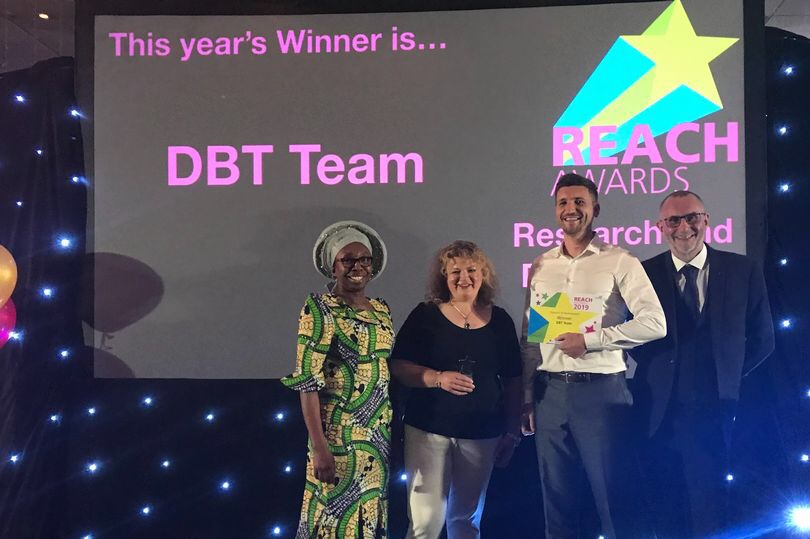
Meet The Psychologists Helping Teens to Manage Mental Health and Reduce Self-harm

The DBT service aims to replace problematic behaviours with skillful ones, help teenagers navigate relationships and experience a range of emotions without necessarily acting on them.

By Bethan ShufflebothamCommunity Reporter

Five years ago there were no specific interventions for young people who were self-harming and feeling suicidal outside of cognitive behavior therapy (CBT) and family therapy.

In December 2014, the Trust’s Children and Adult Mental Health Service (CAMHS), was set up to meet the growing demand of young people with high levels of mental health needs in North Staffordshire.

Specifically, the team assisted teenagers aged 13 to 17 going through emotional difficulties which were causing them to self-harm or attempt to take their own lives.

The aim is to replace problematic behaviors with skillful ones, help teenagers navigate relationships and experience a range of emotions without necessarily acting on them.

Some states now allow students to take “mental health days.” This is an opportunity to start a conversation about how to address mental health in schools. Continue reading…